
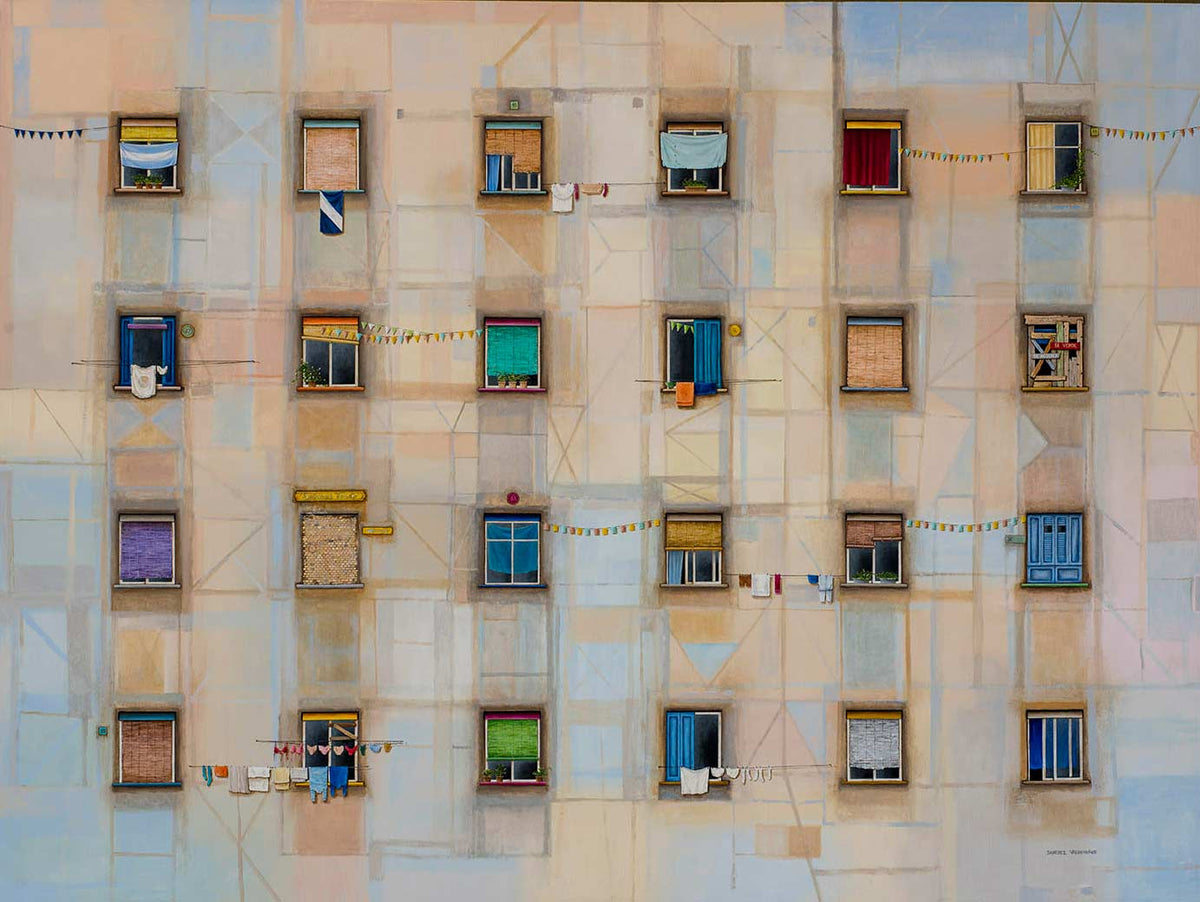
Natalia Sánchez Valdemoros: “I play with human relationships, with time, and with making every window a story”
“I play with human relationships, with time, and with making every window a story”
Natalia Sánchez Valdemoros
Who is Natalia Sánchez Valdemoros
As a child she couldn’t stay consistent with any activity — except painting, which began as play. She likes working with her hands, without needing body and mind in the same place. Doing it that way, she says, gives her freedom.
She is drawn to what is transgressive in Picasso, and to the life and work of Van Gogh. Her references are her three childhood friends, the ones she shares her life with. She has a degree in architecture, but chance brought her back to painting. Now façades appear on her canvases.
She is fascinated by the aesthetics of decay — by repetition and its small modifications as a clue to the human being behind them. She enjoys gathering with friends and family. She dreams of spending summers in Logroño, her Spanish grandparents’ city. While she paints, she listens to audiobooks: fiction, and feminist writing.

The interview
What did you like doing as a girl? Did you know what you wanted to be?
I went everywhere with my notebook, always drawing — but I don’t remember at what point it happened. I didn’t think about the future, I lived in the present. I’ve never been very cerebral; I didn’t question it. What I did want as a child was to do every possible activity: gymnastics, guitar, piano, violin. My mother would sign me up and shortly after I’d quit. I couldn’t be consistent. The only thing that lasted was the painting classes. I did it as play, without thinking about the future. I suppose it was an escape from school. I didn’t much like studying.
Why do you paint?
It’s my trade. I like working with my hands — sometimes with my mind, but I don’t always need it in order to draw. With a trade, you know the steps you have to follow. The mind can free itself, go somewhere else. Doing it that way gives me absolute freedom. I listen to a lot of audiobooks while I paint. My body goes one way and my mind another. Bringing body and mind to the same point is sometimes hard. Painting abstract works like that — I can let myself be carried by the action. Teaching is another matter. Sitting down to draw or paint costs me nothing; I can spend many hours at it.
Which traits define you? Which do you like in others?
I’m very sociable, I like pushing forward, I like cheerfulness. It’s very easy to be drawn to good people; they’re always a magnet. I’m attracted to people who move through life lightly — they don’t have to be especially cultured or educated.
Which artists do you look at?
There are so many… Picasso, for his colours and his transgressive personality. That ease he had for making so much work, and the fact that he loved living. Joseph Beuys’s installations. With Van Gogh, not only his personal story but his painting. But right now there are so many artists I can’t choose. Perhaps the sky painted by someone I don’t know sets something off in me — it’s very hard to be concise. I see art on Instagram all the time, so many images a day. There’s so much that’s unconscious. My teacher, Guillermo Garrido, inspires me enormously, for example. He’s an extraordinary person and I always learn something from him.

Which women have inspired you?
I’d say my circle of friends. I lean on them for everything; they’re very important in my life. I only have a brother, no sisters. We’ve known each other since we were ten. They are my example. My mother too, but that’s more admiration. With them I see myself reflected far more. If I need nourishing, I go to them to share my life.
If you hadn’t devoted yourself to art, what would you have done?
Nobody in my circle told me what I had to be. There are no artists in my family either, so nobody pushed me down that road. I studied architecture, though I never practised. Halfway through the degree I had a crisis because I didn’t like it, and that’s when I met my teacher, Garrido. Life put me back together with painting. My mother told me to take painting up again on the condition that I finished the degree — it seemed a fair deal. Studying architecture didn’t bother me; it was very plastic, nothing like the practice of going to council offices, building sites… The degree is very creative. Before graduating I started exhibiting my paintings and won a prize here, and I got more and more enthusiastic. And today I paint façades. Everything has to do with everything.
What draws you to façades, to space and repetition?
I have always lived in flats, except now that I’m in a house. It struck me when I went to my neighbour’s. I was fascinated by that same but different — the same structure, but with a stamp so unlike my family’s. Repetition and the façade go hand in hand, one stuck to the other. I’m interested in the aesthetics of decay — not as something old or torn down, but the opposite: seeing that time has passed and how the thing holds up. There’s also a personal question of who lives inside: some flats better cared for than others. The small modifications — mouldings, curtains, a wall painted another colour, a plant pot, something that broke and was never repaired. I try to relate façades to human beings, to let you glimpse what is going on: whether it’s abandoned, whether they left, whether there are many people or few. Every window is a story.
How did it start?
By chance. I was doing still lifes, and when that was going well I moved into abstraction. I like it a lot, but it’s painting with the gesture, mixing colours. And in that struggle to make an abstract painting I thought was any good, I couldn’t resolve it and I kept adding layer over layer. One day I walked into the studio and saw it as a completely peeling wall — and that’s when it occurred to me to add windows. That’s how I started, and I haven’t stopped since.
What is your creative process like?
I have a stretcher, and with paper and pencil I work out a structure for how it might be; then I go to the canvas. I always think first about whether the windows are small, what the structure will be, whether there are two buildings joined or only a portion, whether there’s a base or not. It’s a perpendicular look at a section of a building, set out on paper. I mix and make up things I like — with mouldings or railings — but based on reality. Sometimes it comes out worse and sometimes better than the original photograph.
Tell me about your work.
I play with human relationships, with time, and with making every window a story. I want the viewer to move through the piece wondering what story is behind it — and about all the people who pass through that architecture over the years.
How do you know a work is finished?
Generally I abandon it when nothing else occurs to me that I could add. Then I pick them up again in the studio and do something to them. Once I sign it and have the sense that it’s done, I don’t touch it — although afterwards I might want something more. It never really ends…
Small pleasures?
Music, audiobooks, good food and drink. Nothing that isn’t everyday: getting together with family, with friends. Going to an exhibition.
If your life were a film, what would you like to see?
I’d like to find a devotion to my work. I only paint, and a lot; I don’t do anything else. The artist’s daily trade is to make and make. Living in the present is the loveliest thing that can happen to you — enjoying the day, being grateful for what you have. That’s what I’d like to see.
Where would you like to live?
I’d love to have a house in Logroño. My grandparents were from there and I have a close relationship with it, though I haven’t been for a long time. I’d like to spend one summer in Spain and the next here. To relive those moments with them.
Which social issues concern you?
Wars leave me completely thrown. I can’t believe that in 2022 there are still bombs and weapons. That the people organising that disaster are two or three, and everyone else has to obey.
What frightens you?
I’m very permeable, so I don’t watch the news — I don’t contaminate myself with it. Anything makes me ill; my mind takes on everything happening around me, so I try to keep at a distance. I spend time with people who are on the same energetic frequency. That’s my way of protecting myself against fear.
What are you working on?
I’m making façades for a show I have next March. There will be night, colour, black and white… I write the themes down to guide myself, more or less, because otherwise the ideas get forgotten.
Any recommendations?
I loved El tiempo entre costuras by María Dueñas, and La Uruguaya by Mairal. I have a five-year-old daughter, so I read about feminism, because she is going to travel and walk the streets on her own. The awakening of women seems important to me, and I’m grateful to all the ones who go on marches, who put in their bodies and their time, who devote their lives to raising these subjects and winning things.


Natalia on film
Natalia Sánchez Valdemoros is part of United by Art, the programme through which Iskin Sisters invites contemporary women artists to create the art prints that accompany every piece in its packaging.
To see more of her work: @nataliasanchezvaldemoros

Laisser un commentaire
Ce site est protégé par hCaptcha, et la Politique de confidentialité et les Conditions de service de hCaptcha s’appliquent.